Wormhole blamed for Disappearance

A rift in the space-time continuum has been cited as the ‘most likely’ reason Professor James DuClair of Michigan is no longer contactable.

“It’s completely out of character for him to just go wandering off. There’s nothing to suggest foul play, nothing to suppose he might be in hiding,” says a colleague, who refused to be named, “If you know Jay, you know that the only thing that could stop him from coming into work is if he got swallowed up.”

The only evidence to his whereabouts lies in his laboratory, where his notes, equipment and even his desk have vanished. Strangely, CCTV footage shows Professor DuClair entering the premises, but not leaving.

“He couldn’t have moved all of this by himself, and there’s always someone here, so they would have seen something,” says the colleague, “The killer thing is that his research is gone. In a way, it kind of explains what happened.”

When asked about his line of research, we were denied any details, informed only that Professor DuClair was working on ‘Trans-Dimensionsal Propagation of Photons’.ChesterLogoSmall

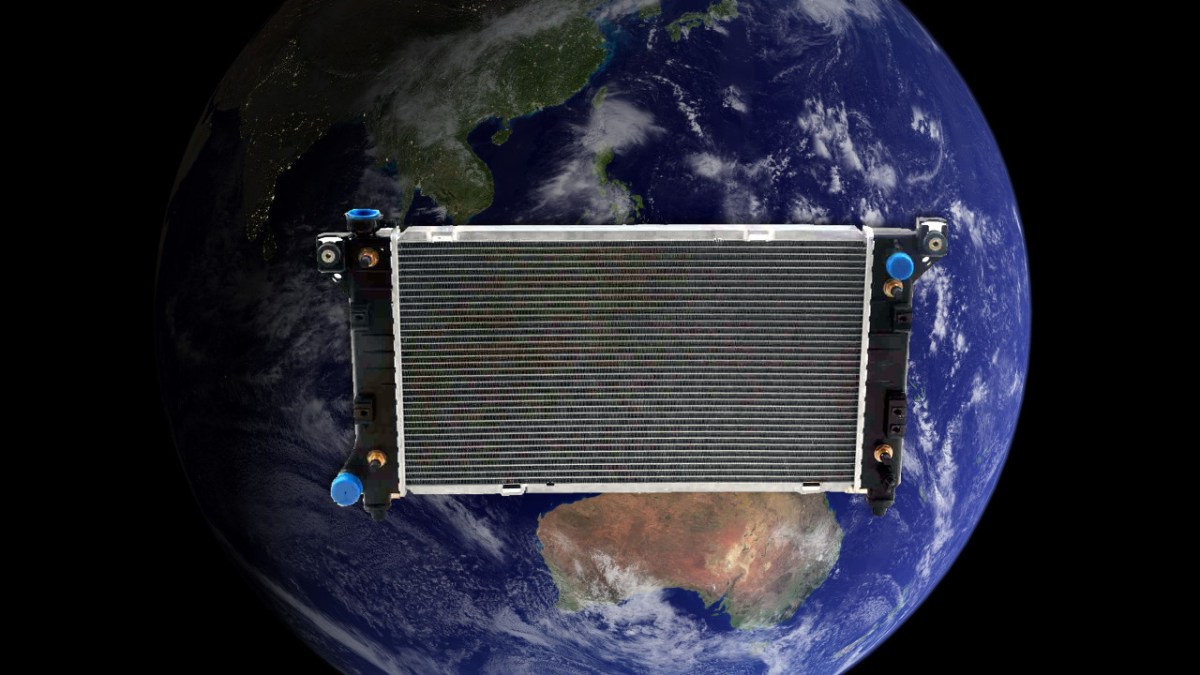
Giant Radiators to Cool the Earth

To address concerns of global warming, scientists in Seattle have proposed the construction of ‘Giant Radiators’ that would act like mammoth size heat-sinks, radiating out unwanted heat into space.

A conventional radiator uses convection, conduction and radiation to sink its thermal energy to the surrounding environment, whereas the new structures would rely solely upon radiation.

“The design is as efficient as we can make it. Still there are intrinsic inefficiencies that are physically impossible to overcome. Nevertheless, these can operate day and night, constantly absorbing ambient thermal energy and radiating it into space, reducing the overall temperature of the globe. Over time, we’re confident this would combat global warming,” says Doctor Pike, a member of the team that put together the proposal, “It’s not dissimilar to what astronauts use to maintain the temperature of their suits, only on a much, much larger scale.”

Since the net motion of energy is out into space, away from Earth, the overall temperature of the Earth will reduce. “The current simulations point to a 0.7 degree drop in average global temperature over a five year period,” says Dr Pike, “Physical trials may prove otherwise, of course, still it’s an exciting prospect.”ChesterLogoSmall